
Compliance responsibilities follow the business. Compliance capabilities need to follow them.
An engineer at a non-US facility needs access to technical information. A local trade professional needs to determine whether an activity falls within an authorization. A project team needs to assess documents before sharing them with a partner.
Each activity depends on information, decision logic, and operational controls. The people performing the work need those capabilities in an environment they can use.
Yet many organizations concentrate compliance expertise and supporting technology at headquarters or within a small number of enterprise systems. Other locations depend on email, spreadsheets, manual handoffs, and access to specialists working in different time zones.
The resulting distance is operational as well as geographic. A location may have a compliance responsibility without the information, tools, or infrastructure needed to carry it out efficiently.
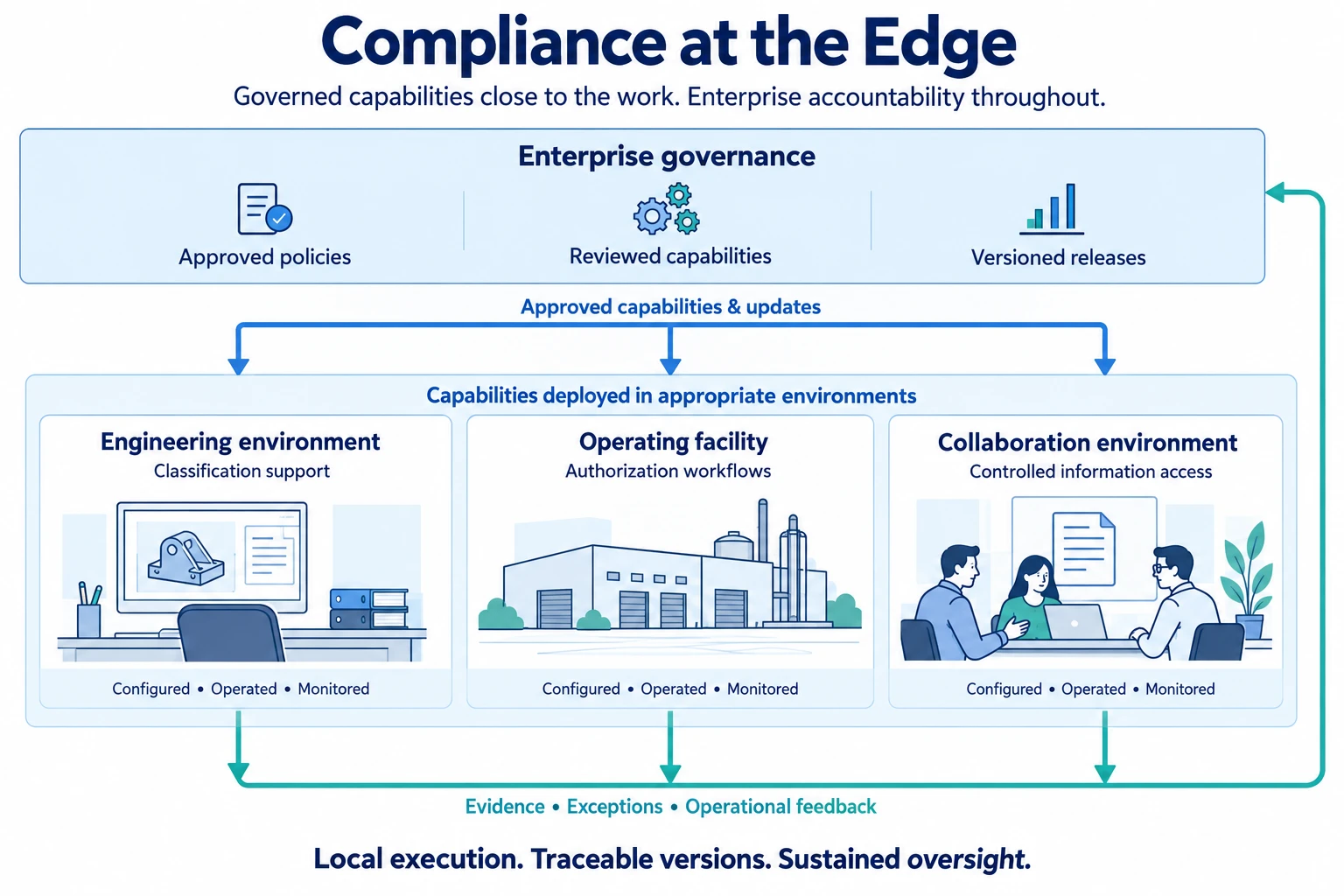
Compliance at the edge means placing governed compliance capabilities close to the activities they serve. It connects enterprise requirements and expertise with the local ability to assess, decide, act, and preserve evidence.
Define the edge by the activity
The edge is wherever a compliance-relevant activity occurs.
It may be a non-US subsidiary, an engineering environment, a manufacturing facility, a supplier collaboration workspace, or a cloud service processing controlled information. It may also be the point at which an AI agent retrieves a document or invokes a tool.
Here, edge describes proximity to the activity and its decision context. A capability may run in a customer-managed cloud environment, a regional deployment, a local data center, or an application integrated with an enterprise service.
The appropriate arrangement depends on the activity, available connectivity, information requirements, security architecture, and applicable restrictions.
The objective is practical: make the right capability available where the work needs it.
Match responsibility with capability
Global organizations distribute compliance responsibilities across legal entities, facilities, functions, and individuals.
Those responsibilities require supporting capabilities. A location expected to manage authorization conditions needs access to the relevant conditions and a way to evaluate them. A team responsible for classifying information needs the applicable methodology, supporting evidence, and a maintained decision record.
A location receiving export-controlled information may also need to manage the conditions under which that information was received and subsequently used or shared.
An enterprise procedure establishes expectations. Local execution requires usable information, workflows, and controls.
Compliance at the edge addresses that relationship. It asks whether each operational responsibility is supported by a capability that can actually be used at the point of activity.
Give ITC a path to deploy infrastructure
The International Trade Compliance function needs an approved way to establish supporting infrastructure when business needs require it.
That might mean deploying an authorization assessment service, a classification workflow, a document analysis capability, or a local interface to enterprise decision information.
ITC should be able to define the need, establish compliance requirements, contribute acceptance criteria, and participate in testing. IT, cybersecurity, data governance, and engineering provide the architecture and operating arrangements needed to deploy and sustain the capability.
A repeatable deployment path makes this collaboration practical. Approved environments, reusable configurations, defined interfaces, and clear ownership reduce the effort required for each new implementation.
The organization can then respond to local needs through an established engineering process.
Make capabilities modular and deployable
Modern, cloud-native architecture supports compliance at the edge by making capabilities easier to package, configure, deploy, and maintain.
A capability can be organized into modular services with defined interfaces. Containerized applications can package software and its dependencies. Infrastructure definitions can describe the resources needed to operate it. Configuration can adapt an approved release to a particular environment.
For example, an authorization capability might include document ingestion, structured records, validation, policy evaluation, a review interface, and connections to operational controls.
Some components may operate centrally while others are deployed near the activity. A local workflow could use an enterprise authorization service, or an approved regional deployment could maintain the information needed for its defined scope.
These choices should follow operational requirements. They include where information may be processed, which systems can connect, how quickly changes must propagate, and what happens when a dependency is unavailable.
Deployability must be accompanied by maintainability: monitoring, updates, support, and an identified operating owner.
Use Git to connect development and deployment
A governed Git ecosystem provides continuity between the capability an organization approves and the versions it operates.
The ecosystem can maintain requirements, data models, rules, code, tests, deployment definitions, and operating guidance. Proposed changes can be reviewed together, checked against expected behavior, and released through a controlled process.
Deployment records can then identify which approved version operates in each environment.
This matters when the same capability serves several locations. Teams need to distinguish common requirements from approved local variations, understand which deployments a change affects, and verify that necessary updates have reached them.
Local configuration should have clear ownership and review requirements. Changes that alter compliance meaning need appropriate assessment, even when they appear technically small.
Git supports the history and coordination of that work. Operational monitoring and deployment records establish what is actually running.
Use AI to develop the capability and prepare its inputs
AI can contribute to compliance at the edge in two connected ways.
First, it can help teams develop and maintain capabilities. Working within the governed engineering environment, AI can assist with models, ingestion routines, interfaces, validation logic, test scenarios, documentation, and deployment definitions.
Second, it can help prepare the information used in decisions. It may extract technical attributes, identify authorization conditions, locate evidence, or flag inconsistencies.
Those outputs can feed deterministic rules and rule sets.
Attribute-Based Classification (ABC) evaluates relevant attributes against classification rules. Attribute-Based Access Control (ABAC) evaluates attributes of the subject, object, action, and environment against access policies.
Both depend on clear attribute definitions and reliable information. AI-extracted facts need evidence, validation, and an appropriate review status. Missing or conflicting facts require a defined response.
The local capability should preserve these distinctions so that a proposed finding is used appropriately and an unresolved fact does not silently become an accepted decision input.
Connect local decisions to enterprise information
A capability deployed near an activity still depends on information that may be maintained elsewhere.
An access assessment may require the current classification of a file, the identity and affiliation of a user, the location of the proposed activity, relevant screening results, and applicable authorization conditions.
Each input needs an authoritative source and a way to communicate relevant changes.
The organization must also decide how current the information needs to be. A local copy may be appropriate for some purposes, but its age, scope, and validity must be understood. Expiration, revocation, and other material changes need a defined path to the capabilities that rely on them.
When a required source is unavailable or information is unresolved, the workflow needs an explicit outcome. Depending on the activity, that may involve stopping the action, requesting review, or using a specifically approved fallback.
These behaviors are part of the compliance design.
Follow a decision at a non-US location
Consider an engineer at a non-US facility requesting a controlled technical file.
A capability available within the approved environment identifies the file and retrieves its current classification record. It establishes the relevant identity, affiliation, and location attributes, then evaluates the proposed action against applicable authorization policy and conditions.
The operational control applies the result. The decision record preserves the information considered, its sources, the policy version, any required approvals, and the outcome.
If a required condition cannot be established, the workflow routes the issue to the responsible reviewer. If the classification or authorization later changes, the organization can identify affected access arrangements and reassess them where necessary.
The engineer receives a usable operational service. The local compliance team receives the information and workflow needed to fulfill its responsibilities. Enterprise oversight receives evidence of how the capability operates.
Preserve governance across distributed operations
Distributed capabilities need clear accountability.
The organization should identify who owns the compliance requirements, who maintains the information, who approves changes, who operates the service, and who resolves exceptions.
Program assurance connects local experience to enterprise improvement. Repeated information gaps may reveal a source-system problem. Frequent escalations may indicate unclear rules. An incident may expose a weakness affecting several deployments.
Shared models, tests, and release processes allow an improvement to be evaluated and applied across the relevant environments.
Useful measures include decision turnaround time, unresolved information gaps, escalation frequency, deployment currency, and the completeness of decision records.
These measures help determine whether local availability is producing effective compliance.
Bring ZT4ECI to the point of activity
Zero Trust for Export Controlled Information depends on evaluating the proposed interaction with information in its relevant context.
That evaluation must be connected to the place where access, processing, sharing, or transfer occurs. The same principle applies when an AI agent acts on a person’s behalf.
Compliance at the edge makes this connection operational. It brings maintained information, tested policies, usable workflows, and enforceable decisions to the environments where people and systems perform their work.
Organizations can begin with one location and one bounded need. The implementation should leave behind reusable requirements, models, tests, deployment definitions, and operating guidance.
Over time, that foundation supports a network of governed capabilities: locally available, connected to enterprise knowledge, and maintained through a common engineering lifecycle.