
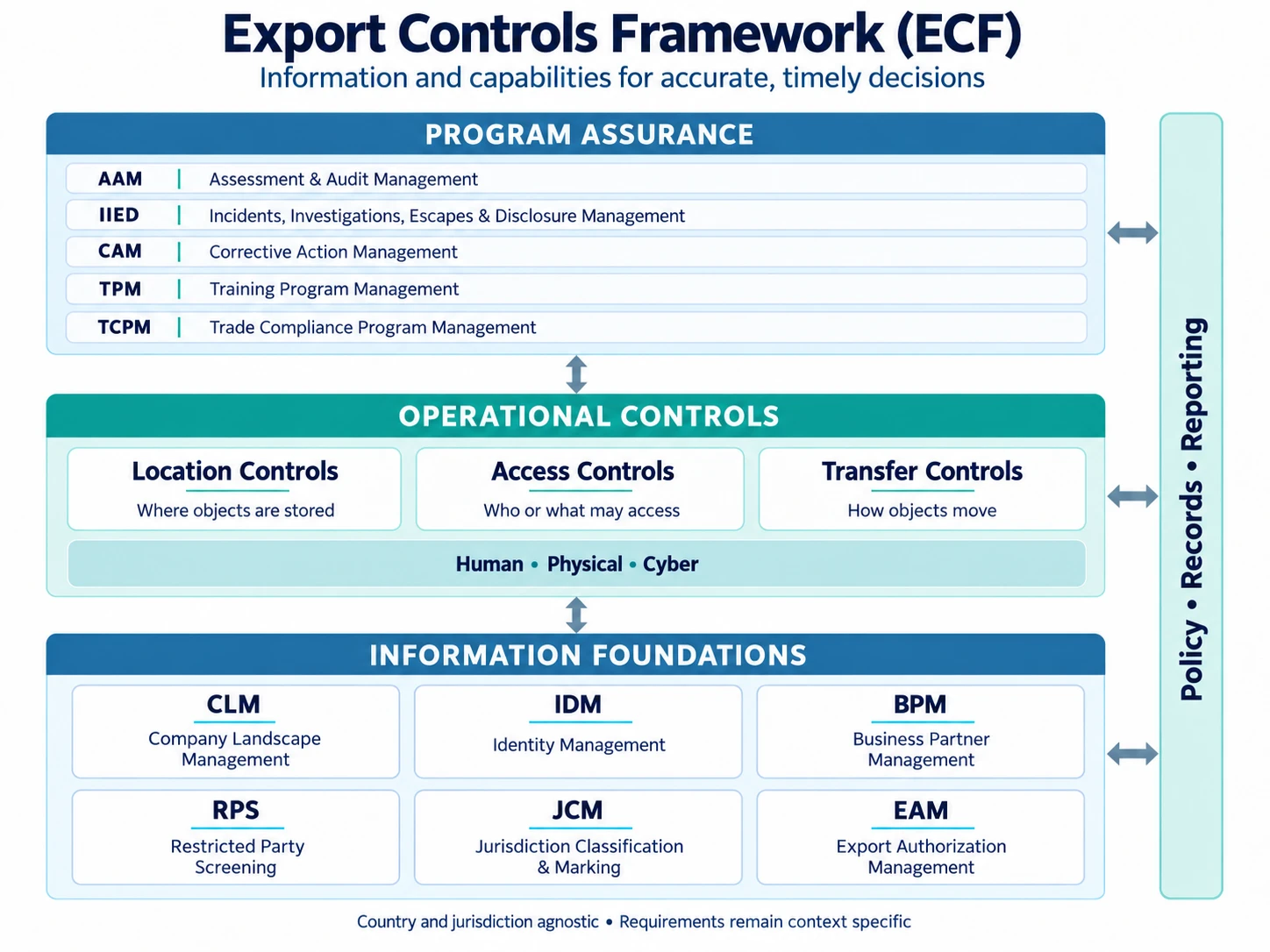
The ECF connects six information foundations, location, access and transfer controls across human, physical and cyber environments, and five program assurance capabilities. Policy, records and reporting connect all three groups.
An export control decision depends on more than knowing what something is. It also depends on who is involved, where they are, what they intend to do, and the authority under which the activity may occur.
That information is distributed across the enterprise. Human resources maintains information about people. Procurement maintains supplier relationships. Engineering maintains product facts. IT maintains systems and infrastructure. Export controls maintains classifications and authorizations. Other functions contribute additional information needed to evaluate an activity.
The quality and timeliness of a decision depend on how well those contributions come together. Even a knowledgeable export controls team can struggle when essential information is incomplete, disconnected, or out of date.
The Export Controls Framework (ECF) brings these dependencies into one view. It identifies the information required for decisions, the operational controls that apply those decisions, and the program capabilities that sustain their effectiveness.
The framework is country and jurisdiction agnostic. Its structure can accommodate different regulatory environments; the requirements and authorities applied to a particular activity remain specific to that activity.
Three connected groups of capabilities
The ECF organizes capabilities into three interconnected groups:
- Information Foundations: Establish and maintain the facts and authorities needed for decisions.
- Operational Controls: Apply that information to the locations, access, and transfers associated with regulated objects.
- Program Assurance: Assess effectiveness, investigate failures, implement improvements, and manage the program.
Throughout the framework, objects include hardware, equipment, materials, software, and information.
These groups operate together. Operational activity can expose missing information. An investigation can reveal a control weakness. A corrective action can require changes to policy, systems, training, or the underlying information.
Policy, records, and reporting connect all three groups.
Establish the information a decision depends on
Six foundational capabilities establish the context needed to evaluate export-controlled activities.
Company Landscape Management (CLM) establishes who the company is, where it operates, and what it does. It includes legal entities, organizational relationships, facilities, systems, cloud environments, and accountable owners. This physical and cyber landscape provides the setting in which people, partners, and regulated objects interact.
Identity Management (IDM) establishes who the company’s people are and maintains the attributes relevant to their activities. Depending on the decision, those attributes may include employment or affiliation, role, location, relevant eligibility information, training, and authorization-related prerequisites. Where systems or agents act on a person’s behalf, their identities and delegated permissions also become relevant.
Business Partner Management (BPM) provides corresponding knowledge about customers, suppliers, collaborators, and other external parties. It includes their identities, organizational relationships, locations, business activities, and roles in proposed transactions. The relationship between a person and a partner entity may be as important as either identity considered separately.
Restricted Party Screening (RPS) identifies and evaluates restrictions affecting entities and individuals. It includes screening, potential-match adjudication, documentation of applicable restrictions, and reassessment when relevant information changes. Screening results must be available to the people and controls evaluating the proposed activity.
Jurisdiction Classification & Marking (JCM) identifies regulated objects and establishes their jurisdiction, classification, and applicable marking. A maintained classification record connects the object to the supporting facts, rationale, approval, and revision history.
Markings communicate classification information. The classification record preserves its basis and current status. This distinction matters when objects cannot carry embedded metadata or when classifications change. The framework accommodates a maintained reference between an object and its classification record.
Export Authorization Management (EAM) manages the authorities applicable to export-controlled activities, including licenses, agreements, exemptions, and exceptions. It connects those authorities to the covered parties, objects, activities, destinations, validity periods, conditions, and prerequisites. Its scope includes determining applicability, maintaining the authority, monitoring its use, and supporting associated records and reporting.
Classification establishes an object’s regulatory treatment and informs the authorization assessment. Authorization establishes the basis under which a particular activity may proceed, subject to its applicable scope and conditions.
Together, these capabilities connect the organization, its people and partners, the object, and the authority relevant to a decision.
Apply that knowledge to locations, access, and transfers
Three complementary control capabilities apply decision information to operational activity.
Location Controls address where regulated objects may be stored, hosted, or processed, and whether those locations provide the required safeguarding and operational capabilities.
Access Controls address who or what may access regulated objects, for which purposes, and under which conditions.
Transfer Controls address the movement, transmission, or release of regulated objects, including the relevant parties, destinations, methods, and conditions.
These controls span the human, physical, and cyber dimensions of the enterprise. They may operate through people following procedures, physical safeguards, system-enforced rules, or a combination of all three.
Their effectiveness depends on the information available to them. A label, screening result, or approval contributes to a decision, but each must be connected to the broader context of the activity.
Follow one decision across the framework
Consider an engineer requesting access to a controlled technical file.
The organization needs to identify the file and its current classification, establish the engineer’s identity and relevant attributes, identify the employing entity and access location, and determine whether an applicable authorization covers the proposed activity. Any prerequisites and conditions must also be satisfied.
The access control applies the resulting decision. Records preserve the information considered, the authority relied upon, any required approvals, and the outcome.
If the request reveals missing identity information, an unresolved screening result, or an unmet authorization condition, the workflow can direct the issue to the responsible owner. Repeated problems may indicate a broader need for corrective action, training, or assessment.
The example illustrates the framework’s central relationship: information supports a decision, controls apply it, and program assurance examines whether the arrangement remains effective.
Maintain decisions as circumstances change
The facts supporting a decision can change.
A person may move to a different location. A partner may become subject to a restriction. An object’s classification may be revised. An authorization may expire, or a required condition may cease to be satisfied.
The ECF therefore requires attention to the continuing quality and availability of decision information. Important information needs an accountable owner, an authoritative source, a review status, and a way to communicate changes to the processes and controls that depend on it.
Changes should trigger reassessment where they affect the basis of an existing decision. This principle applies to both manual workflows and automated controls.
Sustain the program and learn from experience
Five program assurance capabilities help the organization understand risk, respond to problems, and sustain improvement.
Assessment & Audit Management (AAM) evaluates risk and examines whether program requirements and controls are appropriately designed and operating effectively. It directs attention to the activities and dependencies where failures would matter most.
Incidents, Investigations, Escapes & Disclosure (IIED) Management captures events, supports investigations, identifies export controls failures, and manages the evaluation and preparation of disclosures where appropriate. In the ECF, an escape is an export controls failure; determining whether it constitutes a regulatory violation requires assessment of the facts and applicable requirements. Near misses also provide useful evidence for improvement.
Corrective Action Management (CAM) carries remediation through definition, development, implementation, testing, monitoring, and sustainment. It establishes responsibility for correcting underlying causes and verifying that the response remains effective.
Training Program Management (TPM) equips people to perform their responsibilities. It connects role-specific instruction to relevant policies, processes, procedures, tools, records, reporting, and lessons learned.
Trade Compliance Program Management (TCPM) provides visibility into risks, resources, workloads, priorities, and performance. It supports strategic planning and coordinates improvements across the program.
Together, these capabilities turn operational experience into changes that improve future decisions.
Connect policy, records, and reporting
Policy, records, and reporting provide continuity across the framework.
Policy establishes requirements, responsibilities, decision criteria, and escalation paths. Supporting processes and procedures translate those expectations into work.
Records preserve the facts considered, the decision made, its authority, approvals, conditions, and subsequent activity. They should allow the organization to reconstruct what was known and why a decision was made at the time, even when the underlying information later changes.
Reporting makes performance, exceptions, risk, and workload visible. It supports operational management and helps leadership determine where attention and investment are needed.
These capabilities make decisions explainable and provide evidence for oversight and improvement.
Use the framework to guide improvement
The ECF gives export control leaders, business owners, and technical teams a shared view of what the enterprise needs to know and do.
Organizations can use it to map existing processes and systems, identify authoritative information sources, assign ownership, examine connections between approvals and operational controls, and prioritize improvements based on risk and workload.
A capability may span several departments and systems. The framework describes responsibilities and relationships that the organization must support; implementation can reflect its size, operating model, and technology environment.
The practical questions are straightforward: Is the necessary information available and current? Can the relevant control use it? Can the organization explain the resulting decision? And does operational experience lead to improvement?
The Export Controls Framework makes those dependencies visible so the enterprise can manage them deliberately.