Export control decisions increasingly depend on information moving through engineering systems, cloud environments, supplier networks, and AI-enabled workflows. The enterprise must understand that information, the people and systems interacting with it, and the conditions governing the proposed activity.
Drawing on more than 20 years of experience in the Defense Industrial Base, our view is that this challenge requires a connected approach to modernization.
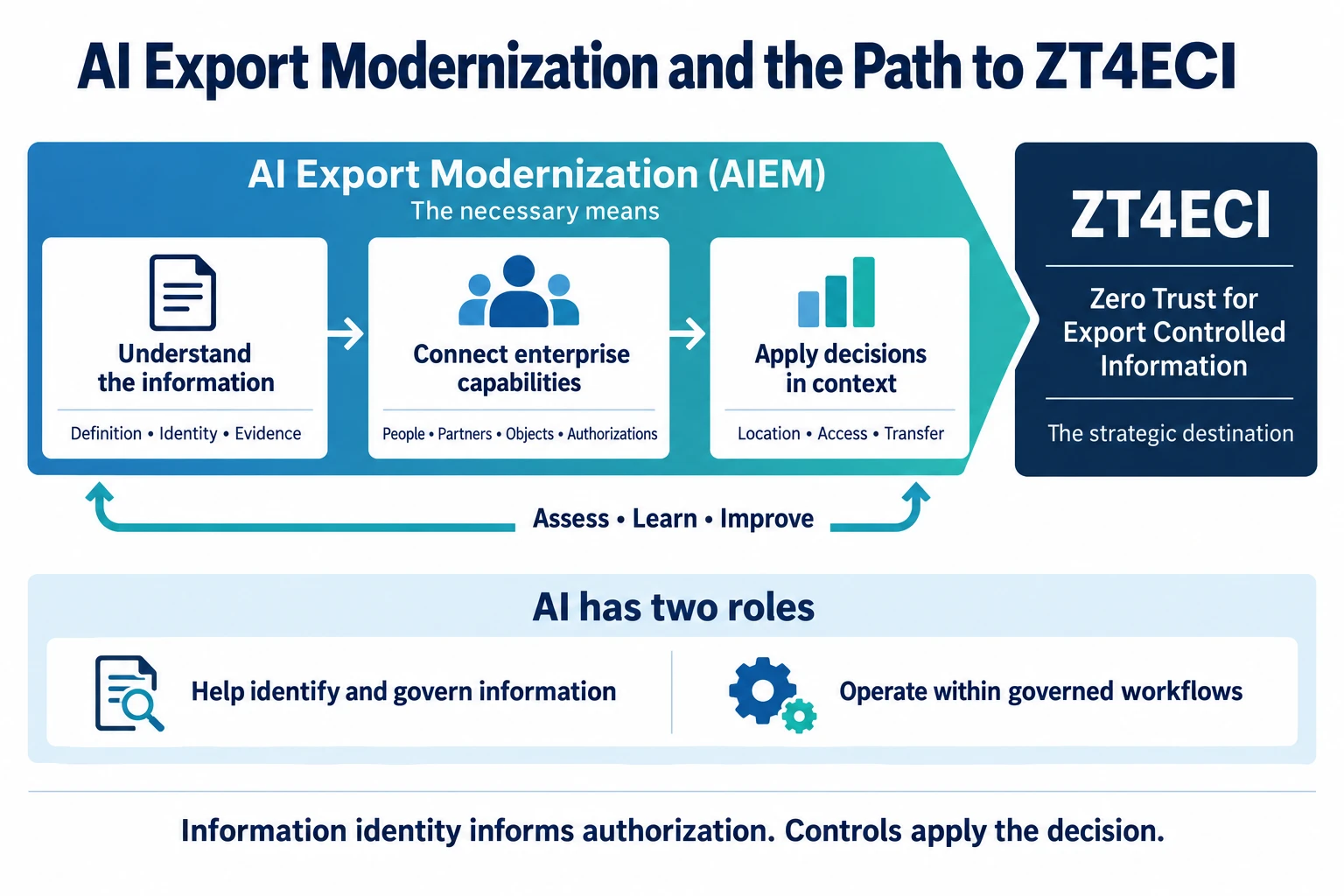
At TC Engine, we call that effort AI Export Modernization (AIEM). Its strategic destination is Zero Trust for Export Controlled Information (ZT4ECI): an operating model in which decisions about regulated information draw on its identity, the proposed activity, and the applicable requirements.
AIEM develops the information and capabilities that make those decisions possible and usable in operational environments.
Start with the information
An organization cannot consistently govern information it cannot identify.
Export Controlled Information (ECI) provides a country- and jurisdiction-agnostic descriptor for information subject to applicable export regulations. A common definition helps people and systems recognize what requires attention. A common identification standard makes the resulting determination usable across organizational and technology boundaries.
The level of detail matters. Coarse-grained identity can support safeguarding. Finer-grained identity connects information to its applicable authority, jurisdiction, and export classification so that those facts can inform release decisions.
The identity of the information is an input to authorization. The decision also depends on the recipient, location, purpose, activity, and applicable conditions.
AIEM begins by making that decision context more complete, consistent, and available.
Give AI a defined role
AI can assist with examining information, identifying potentially relevant technical content, gathering supporting evidence, and proposing determinations for review. It can also help teams find inconsistencies and prioritize information that needs further assessment.
The usefulness of those contributions depends on the foundation around them.
A model needs a clear definition of what it is being asked to identify. It needs relevant examples and access to the context required for the task. Its results need evaluation, and uncertain or conflicting findings need a path to adjudication.
An AI-generated classification suggestion should therefore carry a distinguishable status. A proposed result, a reviewed determination, and a current approved classification serve different purposes.
Modernization includes the means to preserve those distinctions, record the basis for decisions, and communicate corrections to the systems that depend on them.
Connect the enterprise capabilities
Information identification is one part of the larger system.
The Export Controls Framework describes the capabilities that contribute to decisions: knowledge of the company, its people and partners, relevant restrictions, regulated objects, and applicable authorizations. Location, access, and transfer controls use that information. Program assurance evaluates how well the arrangement works and directs improvement.
AIEM connects these capabilities.
A classification maintained in an engineering environment must be available where an access decision occurs. A change in a person’s location may affect an existing approval. An authorization’s expiration must reach the controls relying on it. An investigation may reveal that the underlying information was incomplete or interpreted inconsistently.
These connections are an engineering responsibility as well as a compliance responsibility. They require accountable information owners, consistent meanings, maintained interfaces, and clear handling of missing or unresolved facts.
Move toward decisions grounded in context
In ZT4ECI, a person’s presence inside a network or membership in a group provides only part of the context for an activity involving ECI.
The relevant question is whether the proposed activity is permitted for that person or system, involving that information, under the circumstances that apply.
That requires a relationship between information identity and authorization. Controls need enough context to apply the resulting decision. When the facts supporting it change, the organization needs a way to reassess the activity.
This applies to people and to systems acting on their behalf. An AI agent’s ability to retrieve or process information must be evaluated in the context of its task, its delegated permissions, and the information involved.
AIEM develops the capabilities needed to make those evaluations practical. ZT4ECI describes the destination those capabilities support.
Govern AI’s use of information
AI has two roles in this modernization effort.
It can help the enterprise understand and govern its information. It also becomes a participant in the workflows through which information is retrieved, combined, processed, and shared.
Those roles must be considered together. Improving identification can support more informed decisions about AI access and use. Introducing AI into a workflow creates new points at which those decisions must be applied.
The objective is to carry relevant context into the human, agent, and information interactions that make up the activity.
Make modernization a sustained capability
AIEM is an ongoing effort to improve the enterprise’s ability to identify information, connect decision inputs, apply controls, and learn from operational experience.
Progress should be visible in practical terms: fewer unresolved information gaps, clearer ownership, more consistent determinations, controls that receive the context they need, and records that explain why an activity was permitted or stopped.
That work combines export control expertise with data governance, architecture, engineering, and program management.
AI Export Modernization is the necessary means. Zero Trust for Export Controlled Information is the strategic destination. The path between them is built by connecting the information and capabilities on which sound decisions depend.
Our customer-owned engineering workspace approach keeps requirements, decisions, and work products available to your team as these capabilities develop. An architecture assessment helps identify where to begin.