
Digital transformation changes how controlled information moves through the business. Export controls must shape those changes and use them to develop modern capabilities.
Digital transformation initiatives change where information resides, how people find it, which systems process it, and who can use it.
A cloud migration changes storage and administrative access. A product lifecycle management implementation changes how engineering information is organized and shared. An AI initiative makes information easier to retrieve, combine, and communicate.
Each can change the conditions under which Export Controlled Information (ECI) becomes available to people, organizations, and systems.
Export controls must be embedded in digital transformation. The export-controls profession must also undergo digital transformation to govern intangible exports at scale.
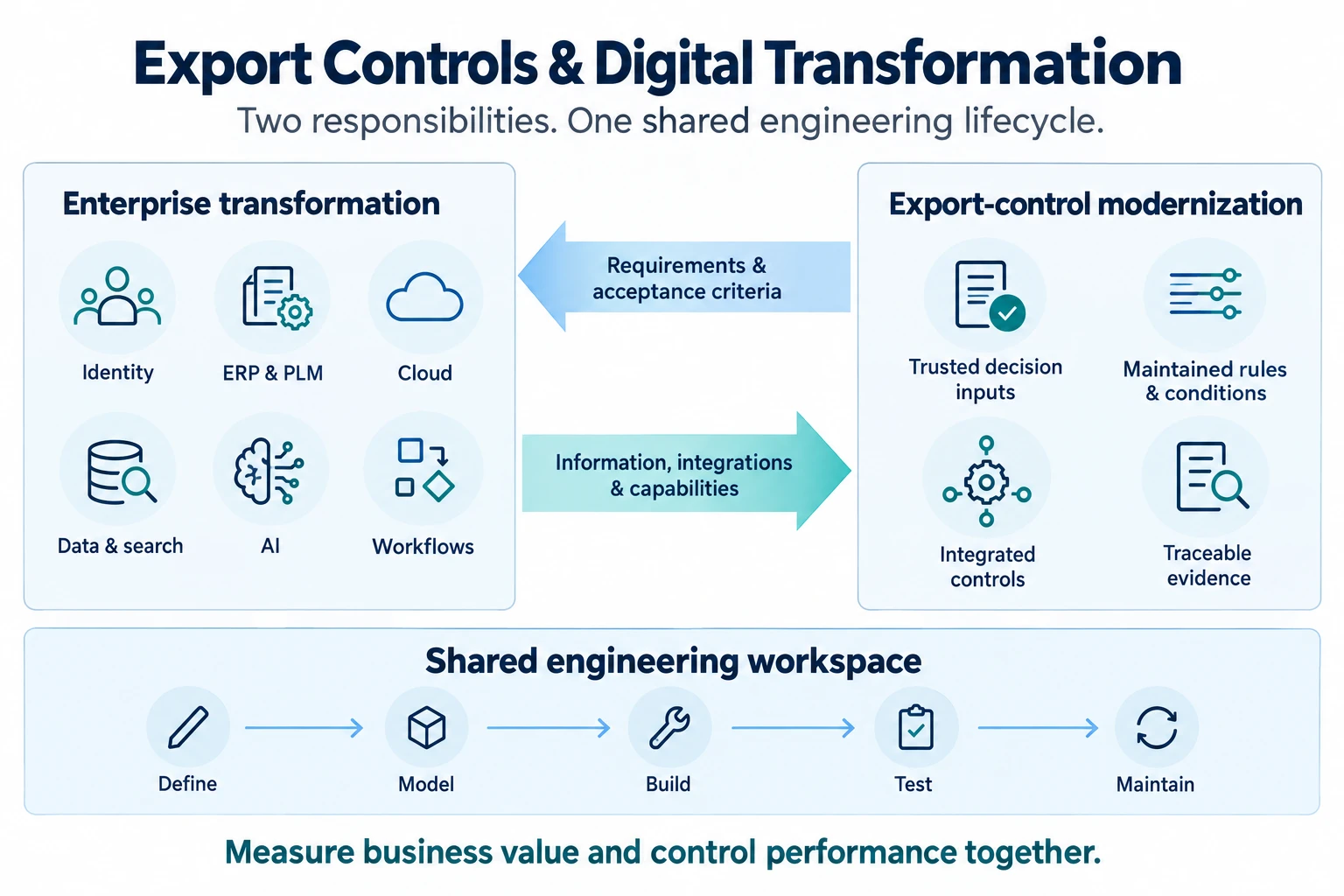
These responsibilities reinforce each other. Transformation teams need export-control requirements to design appropriate system behavior. Export-control teams need the information, integrations, and engineering capabilities those initiatives can establish.
Digital Transformation Changes the Export-Control Environment
An initiative can materially change controlled-information flows without being described as an export project.
Consider an enterprise moving engineering content from regional file shares into a common collaboration environment. The project may consolidate permissions, introduce new support arrangements, change data locations, and enable global search.
The business objective is better collaboration. The export-control questions concern which information is involved, where it will be processed, who can receive it, and which authorization conditions apply.
Those questions belong in requirements and design discussions. Resolving them late can require changes to architecture, migration plans, identity models, or operating procedures.
Digital transformation specialists should therefore treat export controls as a source of system requirements wherever the initiative involves regulated products, software, or information.
Intangible Exports Require Capabilities at the Point of Activity
Physical shipments provide recognizable opportunities for review. Digital activity occurs through file access, software delivery, collaboration, remote support, and automated workflows.
The relevant export-control analysis depends on the information, participants, activity, and applicable regulatory treatment. The operational challenge is that these interactions occur across many systems and at volumes that manual review cannot sustainably govern.
A procedure can establish responsibility. An isolated compliance record can preserve an approval. Operational controls also need the facts and decision logic required to apply that approval where work occurs.
This is why digital transformation of export controls is necessary.
The profession needs the ability to define information requirements, develop maintained decision models, evaluate conditions, integrate controls, and preserve evidence throughout the business workflow.
Bring Export-Control Requirements into the Design
Export-control participation should begin when the initiative defines its business objectives, information flows, and architecture.
Useful design questions include:
- What regulated products, software, or information will the initiative involve?
- Which entities, employees, contractors, suppliers, or other participants will interact with them?
- Where will information be stored, processed, replicated, and accessed?
- Which classification and authorization facts must be available?
- Where should a decision be evaluated and enforced?
- How will incomplete information and exceptions reach qualified reviewers?
- What changes require reassessment?
- What evidence must the system retain?
The answers should become documented requirements, assigned responsibilities, and testable acceptance criteria.
“Export Controls must approve the system” is insufficient as a design requirement. The team needs to understand the behavior the system must support and the evidence that will demonstrate it.
Use Enterprise Initiatives to Modernize Export Controls
Transformation programs often establish capabilities that export-control teams need but cannot efficiently create alone.
The opportunity is to introduce the relevant requirements while the organization is already investing in the underlying architecture.
| Transformation initiative | Export-control requirements to embed | Modernization opportunity |
|---|---|---|
| HR and identity modernization | Relevant participant attributes, validation, lifecycle changes, and controlled access to sensitive identity information. | Make trusted identity assertions available to authorization workflows. |
| ERP and PLM implementation | Persistent object identifiers, classification records, configuration relationships, and change responsibilities. | Connect supported classifications to the systems that create and use product data. |
| Cloud and infrastructure transformation | Relevant storage, processing, support-access, and replication locations. | Establish maintained location and asset information for control decisions. |
| Data platform and enterprise search initiatives | ECI identification, regulatory context, authorization-aware retrieval, and traceability. | Make governed information discoverable while preserving its control requirements. |
| AI adoption | Approved information use, processing arrangements, recipient context, and output handling. | Apply AI to fact extraction, analysis, and development within governed workflows. |
| Workflow and application modernization | Authorization conditions, prerequisites, review paths, and decision evidence. | Replace repeated manual reconciliation with connected evaluation and orchestration. |
These opportunities extend the value of enterprise investment. They also reduce the likelihood of export controls becoming another disconnected application or parallel data-maintenance process.
Modernize the Profession’s Way of Working
Export-control specialists need meaningful participation in the development lifecycle.
Their contribution includes defining regulatory meaning, identifying necessary facts, establishing decision criteria, and evaluating whether the implemented behavior satisfies the intended requirement.
That participation should extend beyond submitting a request and reviewing a finished application.
Specialists need practical ways to inspect data models, refine decision tables, develop examples, and review test scenarios alongside technical teams. Engineers need access to documented reasoning and expected outcomes.
An ITC Engineering Workspace provides a shared environment for that work. Requirements, interpretations, models, rules, tests, and engineering decisions can develop together through defined review and approval paths.
This gives the export-control function a maintained body of knowledge that supports both professional practice and technical implementation.
Make Professional Judgment Reusable
Digital transformation creates opportunities to capture the reasoning behind decisions in forms that can be maintained and applied repeatedly.
A classification methodology can become an approved ruleset. Authorization conditions can become validated decision data. A recurring ambiguity can become an adjudicated example with an associated test.
Professional judgment remains central to establishing and reviewing those artifacts.
The resulting capability allows expertise to reach more activities without requiring the same interpretation to be reconstructed for every request. Missing facts and unresolved conditions can follow explicit review paths.
That is a substantial change in how the profession scales its contribution.
Evaluate Business Value and Control Performance Together
Export-control requirements should participate in the transformation program’s value model.
A design that reduces repeated classification research may release engineering and analyst capacity. A connected authorization workflow may reduce waiting and reconciliation. Evidence captured during execution may reduce later reconstruction.
Those benefits should be measured alongside control performance.
Relevant measures include supported classification coverage, completeness of decision inputs, unresolved authorization conditions, review workload, decision time, and the availability of evidence.
This connects the modernization effort to the broader business case while preserving accountability for the quality of its decisions.
Start with One Transformation Workstream
An organization can begin by selecting an active initiative and tracing one representative controlled-information workflow.
Bring together the transformation lead, export-control specialists, relevant data owners, IT, and cybersecurity. Establish:
- The intended business activity and information flow.
- The applicable requirements and supporting decision inputs.
- The systems responsible for maintaining those inputs.
- The proposed evaluation, enforcement, and review behavior.
- The acceptance criteria and measures of value.
This produces a bounded engineering problem the initiative can incorporate into its plan.
It also gives the export-control team a practical starting point for its own transformation.
Build the Capabilities the Digital Business Requires
Digital transformation expands the business’s ability to create, find, process, and share information. Export-control capability must develop alongside it.
The transformation team’s responsibility is to incorporate relevant requirements into the architecture. The export-control function’s responsibility is to express those requirements in forms that can be implemented, tested, and maintained.
Embed export controls in digital transformation. Use digital transformation to modernize export controls. Both are necessary to support authorized global operations in a business built on software and information.
Related reading
- Count the Cost of Compliance: The ROI Case for AI Export Modernization
- Why International Trade Compliance Needs Its Own Git Ecosystem
- AI Export Modernization and the Path to ZT4ECI
Connect your transformation initiative to export-control requirements
TC Engine works alongside transformation, export-control, IT, and cybersecurity teams to assess dependencies, define requirements, and implement agreed capabilities.