
Trade-control investments should improve compliance and the business’s ability to operate. That accountability matters before a failure—and throughout remediation.
ITAR Consent Agreement investments should generate ROI.
That statement can make compliance professionals uncomfortable. Regulatory obligations must be satisfied. Required controls must operate. Those responsibilities remain.
But the way an organization meets those responsibilities has consequences for its operating costs, engineering capacity, delivery schedules, and ability to collaborate.
Compliance workflows that consume increasing resources without improving business performance become difficult to sustain. When those workflows obstruct necessary activity, pressure builds to work around them.
ROI is central to securing funding before a disaster and directing investment after one.
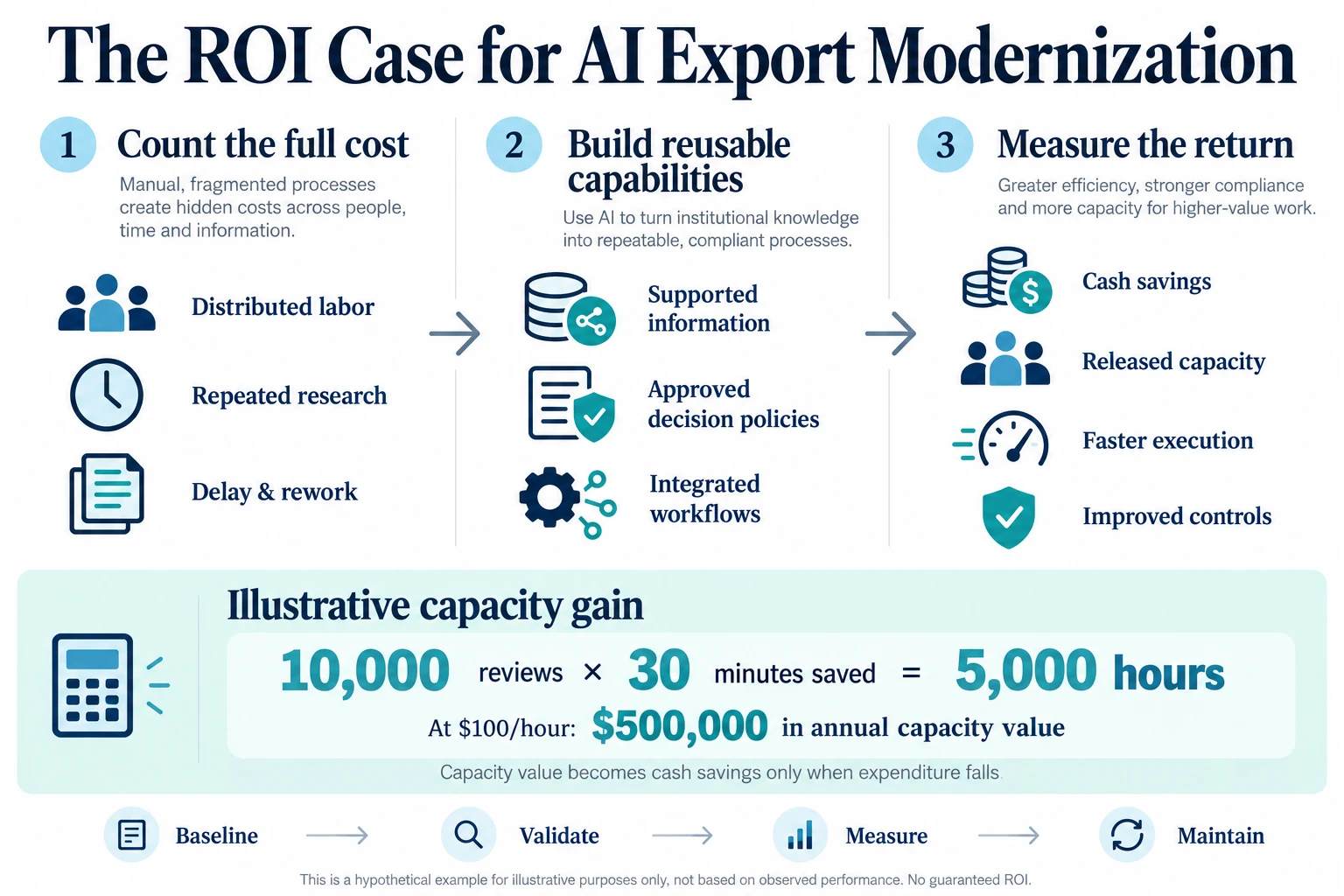
The Cost Extends Beyond the Compliance Department
A trade-control budget captures only part of the enterprise’s compliance cost.
Engineers research product characteristics for classification requests. Program teams wait for decisions. Employees assemble information already held elsewhere. IT administrators maintain groups and exceptions. Export professionals reconcile inconsistent records and reconstruct evidence for reviews.
Much of this work appears in someone else’s budget.
An assessment of compliance cost should include the labor distributed across those functions, along with rework, external support, technology operation, and maintenance. It should also examine the business consequences of delay.
A classification backlog may consume analyst time while holding up procurement or engineering activity. An authorization process may involve several departments before anyone has enough information to decide whether an activity can proceed.
Counting only the export team’s effort understates the cost of the operating model.
Manual Process Debt Compounds
Every unresolved classification, disconnected record, and undocumented decision creates future work.
When reasoning remains in an email, the next analyst may repeat the research. When authorization conditions remain buried in a document, each transaction may require someone to interpret them again. When systems lack shared identifiers, employees repeatedly reconcile records.
This is manual process debt.
As activity grows, that debt increases the effort needed to perform routine work. Adding people can relieve immediate pressure while leaving the underlying causes intact.
Modernization should reduce the amount of repeated work the organization carries forward.
Before the Disaster: Build a Fundable Business Case
Fear of enforcement can attract attention. A measurable operating problem gives leadership something concrete to fund.
A strong proposal identifies the affected population, establishes the current cost, and defines the capability that will improve it.
For example:
- How many classification requests repeat research already performed?
- How much engineering time supports each determination?
- How long do complete requests wait for a decision?
- How much effort goes into interpreting authorization conditions?
- How much work is required to assemble evidence for an audit?
- Where does increasing volume require a proportional increase in staffing?
These questions connect compliance requirements to business performance. They also establish a baseline against which the investment can be judged.
The objective is to fund improvements while there is still an opportunity to implement them deliberately.
After the Disaster: Make Remediation Produce Durable Capability
An enforcement event creates urgency and can unlock resources that were previously unavailable.
That investment should leave the organization better able to operate after the remediation effort ends.
A project can close findings while leaving behind expensive manual dependencies. Additional reviews, temporary teams, and repeated reconciliations may satisfy an immediate need yet establish a recurring cost the business must absorb indefinitely.
Each remediation workstream should therefore answer two questions:
Does this address the underlying control failure?
What maintained capability will remain when the project team leaves?
Useful outcomes include supported classification records, reusable decision policies, accessible authorization data, integrated enforcement, and evidence captured during normal execution.
Those capabilities help prevent the organization from paying repeatedly to solve the same problem.
Measure the Return Accurately
ROI requires clarity about what a benefit represents.
| Benefit | What to measure |
|---|---|
| Cash savings | Expenditure actually eliminated or reduced. |
| Capacity released | Staff hours made available for other work. |
| Cost avoidance | Future expenditure no longer required under a supported forecast. |
| Faster execution | Reduced processing and waiting time, with an identified business consequence. |
| Improved control performance | Better coverage, fewer errors, more consistent decisions, and stronger evidence. |
These benefits should remain distinguishable.
Consider an illustrative workflow involving 10,000 annual reviews. Reducing average handling time from 45 minutes to 15 minutes releases 5,000 hours. At an assumed fully burdened labor rate of $100 per hour, that represents $500,000 in annual capacity value.
It becomes cash savings only when expenditure actually falls. Otherwise, the business case should explain how the organization will use that capacity—for example, to clear a backlog, support growth, or address higher-risk work.
Investment calculations must also include implementation, integration, expert validation, operation, and ongoing maintenance. Avoid counting the same benefit twice when released capacity, cost avoidance, and faster execution overlap.
The Return Grows When Decisions Become Reusable
One of the strongest opportunities lies in changing how much value each unit of compliance work produces.
A classification determination can become the basis for an approved rule applicable to an evidenced population. An authorization can become maintained decision data used across relevant workflows. A regulatory interpretation can become a versioned policy with documented approval and test cases.
The organization then gains value from applying governed knowledge repeatedly.
This is where mass classification analytics, Attribute-Based Classification, and machine-actionable authorization become economically significant. They allow expert effort to support a broader population while directing exceptions and unresolved facts back to qualified reviewers.
The return comes from both the immediate improvement and the reuse that follows.
AI Export Modernization Needs Outcome Accountability
AI can help extract facts, navigate documents, reconcile records, and develop classification rules. Those activities create value when they improve an operating outcome.
A successful demonstration should establish how much work was reduced, whether decision quality improved, what required human correction, and what it will cost to sustain the capability.
The same discipline should govern production deployment. Faster processing has limited value if it creates more downstream review or propagates unsupported decisions.
Define the baseline, validate the change, measure the result, and maintain the capability.
Count the cost of compliance. Make that cost visible across the business. Use it to justify AI Export Modernization—and hold the investment accountable for the improvement it delivers.
Related reading
- AI Export Modernization and the Path to ZT4ECI
- Stop Looking at the Classification Elephant Through the Transactional Keyhole
- Why International Trade Compliance Needs Its Own Git Ecosystem
Put the business case to work
An Export Controls Architecture Assessment can help identify recurring work, capability gaps, and implementation priorities. Where included in scope, the assessment establishes a baseline for measuring operating cost and business value.