
Export classification often enters the business workflow as a question about a transaction: What is the classification of this part, software package, or technical document so the activity can proceed?
An analyst gathers information, evaluates the item, records a determination, and releases the transaction. The next request arrives, and the process begins again.
Each request provides a narrow view of a much larger classification problem. Behind that transaction may sit thousands of related parts, shared technical characteristics, common development histories, and existing determinations that could inform an entire population.
We need to stop looking at the classification elephant through the transactional keyhole.
The opportunity is to understand the population, identify the facts that govern its classification, and establish policies that can produce supported decisions at scale.
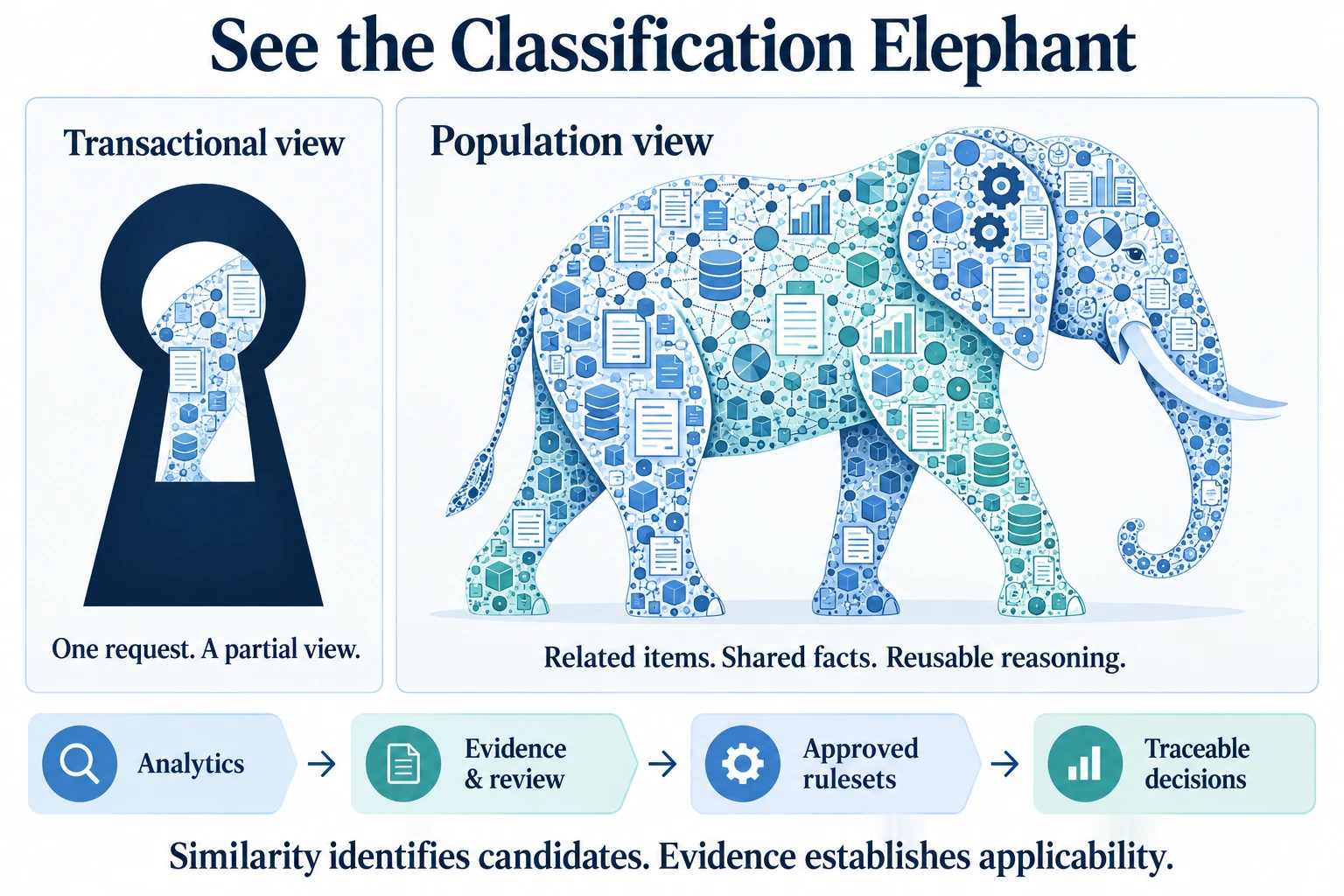
The transaction is one use of the classification
A transaction creates demand for a classification. It does not define the full scope of the classification’s value.
The same item may appear in multiple orders, bills of material, engineering systems, supplier records, and maintenance activities. Its classification may inform many subsequent decisions.
When classification work remains organized around incoming requests, the organization can repeatedly research facts it already possesses. Related items receive separate treatment. Useful reasoning remains buried in individual records, emails, or an analyst’s memory.
A completed transaction can therefore conceal unfinished enterprise work: the organization has answered the immediate question without applying what it learned to the broader population.
Mass classification begins with analytics
Mass classification analytics examine the population before treating every item as a separate research assignment.
An indented parts list, for example, provides more than a queue of part numbers. It reveals assemblies and components, recurring descriptions, manufacturers, standard-part patterns, alternate references, and relationships to end items. Existing classification records add another layer of evidence.
Together, those sources help answer questions such as:
- Which items already have supported determinations?
- Which records refer to the same item under different identifiers?
- Which populations share facts relevant to a regulatory criterion?
- Where do classifications conflict?
- Which missing facts prevent a decision?
- Which existing determinations could support a reusable rule?
These are classification questions at the population level. Their answers help determine where research, expert review, and automation will have the greatest effect.
Analytics identify candidate populations. Evidence and approved decision logic establish whether a classification can be applied.
Similarity helps find candidates
A shared description, manufacturer, or position in an assembly can help identify items worth evaluating together. Those relationships do not automatically establish a shared classification.
Two parts described as “brackets” may have materially different development histories or applications. Two documents associated with the same controlled product may convey different information and require different treatment.
The task is to identify classification-relevant equivalence: the facts that justify treating items alike under a particular rule.
That distinction allows analytics to accelerate research while preserving the basis for each determination. It also exposes where apparent similarity breaks down.
Rules make the reasoning reusable
A classification rule expresses the conditions under which a particular outcome applies.
A useful rule identifies the population within its scope, the required facts, the relevant regulatory basis, applicable exclusions, and the resulting determination. It also establishes what happens when evidence is missing or contradictory.
For example, a precedent-based rule might apply an approved determination to additional records representing the same manufacturer and part number, subject to verification of revision and configuration. A broader rule might address a population whose members satisfy the same documented regulatory criteria.
The breadth of the rule must follow the breadth of the evidence.
A rule supported for one configuration cannot silently expand to every similarly named item. When a required fact is unavailable, the result should remain unresolved or route for review.
Rulesets turn individual rules into classification policy
A ruleset, or classification policy, organizes rules into a governed decision process.
It establishes which rules apply, how they interact, their order of evaluation where relevant, and how conflicts or exceptions are handled. It defines the outcomes the organization permits, including decisions that require additional evidence or approval.
This is the foundation of Attribute-Based Classification (ABC): evaluating documented attributes against rules and rulesets to produce deterministic classification decisions.
Given the same facts and the same policy version, the evaluation should produce the same result. Reviewers should be able to inspect which conditions were satisfied and why the outcome followed.
That consistency makes classification logic testable and maintainable. Changes to facts or policy can trigger a targeted reassessment of affected populations.
Precedent becomes an enterprise asset
A prior classification contains more potential value than its final designation.
Its supporting facts, scope, regulatory analysis, and approval may establish a basis for evaluating other records. Mass analytics help identify where that precedent could apply.
The work is to make the applicability conditions explicit, validate the candidate population, and approve a rule that captures the supported reasoning.
Precedent propagation is one application of ABC. Other applications evaluate technical thresholds, enumerated descriptions, exclusions, or other relevant criteria.
Each approved rule adds reusable classification capability to the organization.
Scaled decisions need durable records
Applying a policy across thousands of items must produce records that explain the results.
Each decision should retain the evaluated object and configuration, supporting evidence, policy version, rules applied, outcome, and relevant approval. A mass classification record should also identify the evaluated population and its exceptions.
A classification decision hash can identify a specific decision record and support integrity checking. Referencing that hash in an ECI Identification Standard manifest connects the communicated classification to its supporting determination.
This gives downstream systems a route from a classification attribute back to the evidence and policy that produced it.
Measure the population, not just the queue
Transaction-oriented metrics emphasize requests completed and turnaround time. Mass classification adds measures of enterprise coverage:
- The population covered by current, supported determinations.
- The proportion evaluated through approved policies.
- Unresolved records grouped by missing fact or evidence.
- Conflicting determinations requiring adjudication.
- Populations affected by a regulatory or policy change.
These measures reveal whether the organization is building durable capability or repeatedly answering isolated questions.
The next classification request still matters. It also presents an opportunity to ask a larger question:
What can this determination teach us about the rest of the elephant?