International Trade Compliance (ITC) runs on knowledge: regulatory requirements, interpretations, product facts, classifications, authorizations, procedures, and the experience of the people applying them.
Much of that knowledge lives in documents, spreadsheets, email, business systems, and individual memory. Each serves a purpose. The challenge is maintaining the relationships among them as requirements change and the organization grows.
A revised interpretation may affect a classification methodology. That methodology may support thousands of decisions. Those decisions may inform access controls, authorization assessments, and business workflows. The organization needs a way to understand what changed, evaluate its consequences, and carry approved changes into operation.
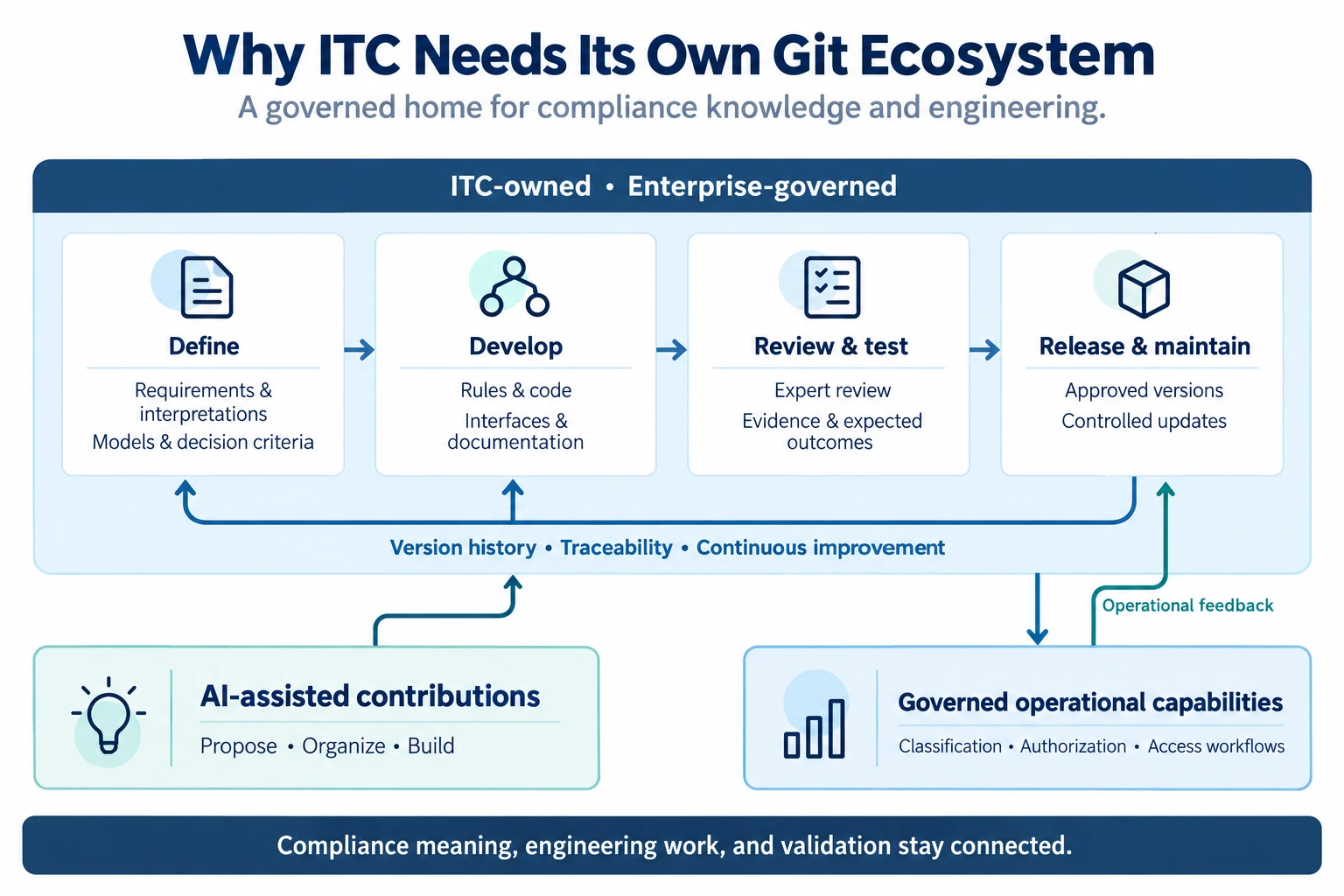
The ITC function needs its own Git ecosystem: a governed engineering environment for developing, reviewing, testing, and maintaining the knowledge and capabilities on which compliance depends.
From documents to maintained capabilities
A procedure describes how work should be performed. A decision table expresses how facts affect an outcome. A data model defines what information a process requires. Code can collect that information, apply rules, route exceptions, and preserve records.
These artifacts belong to the same compliance capability.
Consider a classification workflow. Its supporting materials may include:
- The applicable regulatory provisions and source references.
- An approved interpretation and classification methodology.
- Definitions of the technical attributes needed for assessment.
- Rules that evaluate those attributes.
- Examples and tests demonstrating expected outcomes.
- Instructions for resolving missing facts and ambiguous cases.
- Interfaces to engineering and classification systems.
- Deployment configurations and operating guidance.
When these materials evolve independently, the organization can lose alignment between its documented approach and its operational behavior.
A Git ecosystem provides a way to maintain them together and make their relationships explicit.
What a Git ecosystem provides
Git records changes to files over time. It allows contributors to work on proposed changes, compare versions, and preserve a history of the work.
The surrounding ecosystem adds collaboration, review, issue tracking, automated checks, release management, and deployment workflows. Platforms such as GitHub, GitLab, and Bitbucket support these activities.
For ITC, the value is a controlled lifecycle for compliance artifacts.
A proposed change can be connected to a business need or regulatory development. Reviewers can examine its effect on requirements, logic, documentation, and tests. Approved versions can be released for use, with records showing what was changed and why.
This also helps distinguish working material from approved guidance. A draft interpretation, an experimental rule, and a released policy can have clearly defined statuses and review paths.
The ecosystem becomes a shared workspace in which compliance expertise and engineering work remain connected.
What ITC should own
ITC ownership begins with accountability for compliance meaning.
The function should be able to define requirements, document interpretations, establish decision criteria, identify acceptable evidence, and determine whether a capability performs its intended compliance purpose.
Technical responsibilities remain collaborative. IT and engineering contribute architecture, integration, development, and operations. Cybersecurity establishes relevant security requirements. Data owners remain responsible for the information their systems provide.
A shared environment makes those responsibilities easier to coordinate. An ITC specialist can explain the intended outcome. An engineer can show how it has been implemented. A reviewer can evaluate the evidence that connects the two.
ITC also needs practical access to the development process. Its participation should extend beyond submitting a request and reviewing a finished application. Subject-matter experts need opportunities to inspect models, refine decision tables, review test scenarios, and evaluate proposed changes throughout the work.
Give compliance knowledge a usable structure
AI and automation work more effectively when knowledge has clear organization, meaning, and status.
A maintained ITC workspace can bring together requirements, definitions, approved interpretations, data models, classification methods, authorization models, policy rules, test scenarios, and decision logs.
The relationships matter as much as the individual artifacts. A rule should identify the requirement it implements. A test should identify the behavior it evaluates. A deployment should identify the approved release it uses.
This structure preserves institutional knowledge and makes it easier to reuse. A new team member can examine the reasoning behind a methodology. An engineer can identify the attributes a workflow needs. An AI assistant can work from the organization’s maintained definitions and approved examples.
Source authority must remain clear. Regulatory text, internal interpretation, working assumptions, and approved operating guidance have different roles. The workspace should preserve those distinctions.
Connect AI to the development lifecycle
AI can help ITC produce and maintain capabilities.
It can assist with organizing requirements, drafting data models, developing extraction routines, proposing rules, generating code, creating test scenarios, and updating documentation. It can also examine changes across related artifacts and identify possible inconsistencies.
Git gives that work a reviewable form. AI contributions become proposed changes that people can inspect, test, revise, and approve.
For example, an ITC specialist may describe the information needed to determine whether a proposed activity falls within an authorization. AI can help turn that description into a structured model, a validation routine, and an initial set of tests.
The team can then examine whether the model captures the relevant conditions, whether the routine handles incomplete information appropriately, and whether the tests cover meaningful cases.
The resulting capability remains available for future improvement. Its requirements, implementation, and validation history develop together.
Develop the inputs to deterministic policies
Many compliance capabilities depend on obtaining reliable attributes and applying defined rules to them.
AI can help extract technical characteristics from documents, identify parties and conditions in authorizations, map fields between systems, and locate supporting evidence. It can also help build the repeatable processes that perform those tasks.
Those attributes can feed Attribute-Based Classification (ABC) rules. Classification results can then contribute to other policies, including Attribute-Based Access Control (ABAC) decisions involving identity, information, requested action, and environmental context.
The Git ecosystem supports development and testing across this chain.
Attribute definitions, extraction methods, validation requirements, classification rules, and access policies can each be maintained and reviewed. Tests can examine the effect of missing, conflicting, or changed attributes.
A repeatable rule outcome still depends on appropriate inputs and valid logic. Preserving those dependencies helps teams identify where a problem originated and what must be corrected.
Test the compliance meaning
Software can execute successfully while producing an inappropriate compliance outcome.
Tests therefore need to examine the intended decision behavior. Relevant scenarios include qualifying cases, exclusions, boundary conditions, unmet prerequisites, expired authorities, unresolved facts, and contradictory evidence.
ITC specialists should help define these scenarios and their expected outcomes. Engineers can turn suitable cases into repeatable checks that run when the capability changes.
Testing also makes interpretations more precise. If reviewers disagree about the expected result, the scenario has exposed a question that needs resolution before deployment.
Over time, the test collection becomes a maintained record of how the organization expects the capability to behave. It helps protect approved behavior when rules, models, interfaces, or code are revised.
Support compliance at the edge
A governed development environment also supports deployment where compliance capabilities are needed.
A non-US facility may require an authorization workflow, a local classification service, or a capability that evaluates access to controlled information. ITC needs an approved path to provision and operate the supporting infrastructure.
Cloud-native architecture can make those capabilities modular and repeatable. The repository can maintain application code, policies, infrastructure definitions, configuration templates, and deployment instructions.
An approved release can then be deployed into an appropriate environment, configured for its intended activities, and monitored throughout its lifecycle.
This is compliance at the edge: placing governed capabilities close to the work they serve while preserving enterprise accountability.
The engineering ecosystem provides continuity between the approved capability and its deployments. Teams can identify which version operates at a location, assess whether a change applies, and verify that an update has been implemented.
Keep operational information in appropriate systems
An ITC Git ecosystem needs a deliberate information architecture.
Repositories are well suited to models, code, rules, tests, documentation, and configuration definitions. Operational records, personal information, controlled technical content, and credentials need storage and access arrangements appropriate to their requirements.
The workspace can reference those systems through maintained interfaces and identifiers. Test cases can use synthetic or appropriately governed examples where practical.
The repository itself also requires suitable hosting, access controls, review permissions, and operating procedures. Its content and contributors should determine those arrangements.
These decisions allow the ecosystem to support compliance engineering without treating every information asset as a repository file.
Start with one useful capability
ITC can begin with a bounded workflow that has a clear owner and a measurable need.
A classification decision table, an authorization data model, a document ingestion routine, or a recurring validation task can provide a practical starting point.
The initial work should establish the requirement, supporting information, review process, meaningful tests, and a maintained release. It should also leave enough documentation for another person to understand and continue the work.
As the ecosystem develops, useful artifacts accumulate: definitions, models, approved rules, tests, interfaces, and deployment patterns. Subsequent work can build on that foundation.
Progress is visible when changes become easier to review, knowledge becomes easier to recover, repeated work decreases, and operational capabilities remain aligned with approved requirements.
The ITC function needs the ability to shape and sustain the systems on which its decisions depend. A governed Git ecosystem gives that responsibility a practical home—and gives AI-assisted modernization a foundation the enterprise can inspect, maintain, and trust.
Put the workspace into practice
Explore ITC Engineering Workspace Setup & Enablement for help establishing the environment, review workflows, and an initial workstream with your team.