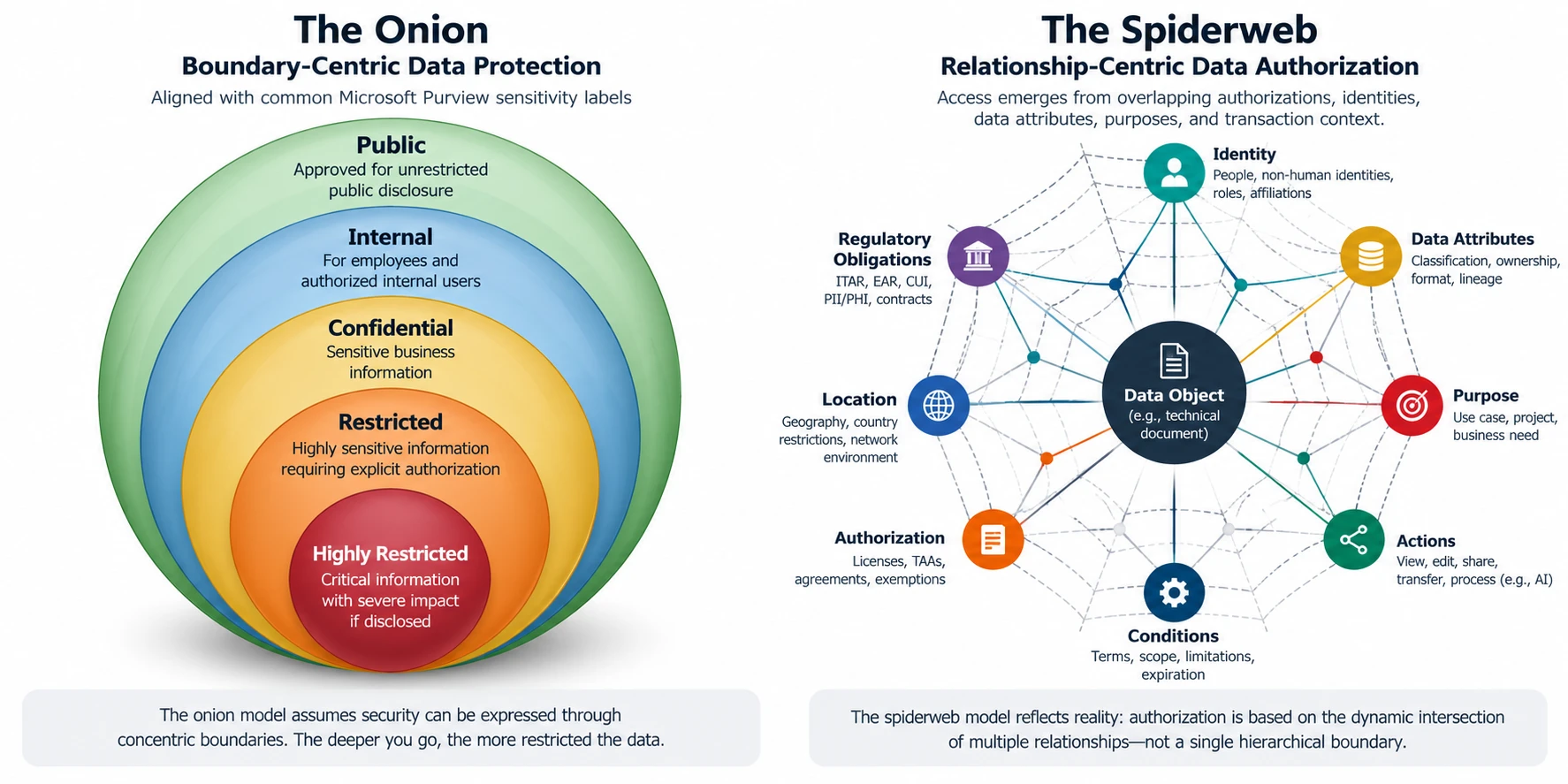
Security teams have spent years building stronger boundaries around information. Networks, applications, repositories, and sensitivity labels help organizations decide how carefully information should be protected. The familiar image is an onion: layers of protection surrounding increasingly sensitive data.
Those layers remain important. But modern collaboration raises another question: who is authorized to use this information, for what purpose, and under which conditions?
That question becomes especially important for Export Controlled Information (ECI). Protecting a document and determining whether a particular person may receive or use it are distinct responsibilities. A secure environment is part of the answer; the relationships surrounding the information matter too.
The onion explains protection
The onion is a useful way to think about safeguarding. Information sits within organizational and technical boundaries, and its sensitivity influences the protections applied to it.
This gives people a shared language for handling information. It helps establish expectations about sharing, access, and disclosure. It also supports the practical work of cybersecurity teams responsible for protecting enterprise systems.
The limitation appears when we ask those boundaries to answer every authorization question. A label describes an aspect of the information. A group describes a set of users. Neither, on its own, explains every relationship between a particular person, a particular document, and a proposed activity.
The spiderweb explains relationships
Consider an engineering document used across a global supply chain. One partner may be authorized to use it for a defined project. Another may need different information or operate under different conditions. Even within the same organization, access may depend on a person's role, the activity, and the applicable authorization.
These relationships overlap. They do not fit neatly into a single hierarchy running from public to highly restricted.
The spiderweb offers a more useful picture of that complexity. Information is connected to identities, classifications, authorities, purposes, locations, actions, and conditions. An access decision depends on the relevant relationships coming together for the proposed interaction.
The same information can therefore require different decisions in different circumstances. The objective is to understand those circumstances well enough to support authorized collaboration while preventing inappropriate disclosure.
Why this matters now
Engineering work increasingly crosses organizational boundaries. Suppliers, distributed teams, cloud services, and AI-enabled workflows all create new ways for information to move and be used.
When the underlying authorization relationships are unclear, organizations often compensate with more groups, more exceptions, or more manual review. Over time, the administrative burden grows, and teams struggle to distinguish a necessary restriction from an avoidable obstacle.
Human judgment remains essential. The challenge is to make that judgment useful beyond a single approval: to give the organization a consistent understanding of what is authorized and what conditions apply as people, projects, and circumstances change.
For business leaders, this is a collaboration issue as much as a security issue. Excessively broad access creates risk. Excessively narrow access delays legitimate work. A stronger understanding of authorization helps organizations navigate both concerns.
A shared responsibility
Export-control teams bring the meaning of classifications, authorities, and conditions. Cybersecurity and IT teams bring the capabilities that protect information and govern its use. Engineering and business teams bring the context of the work itself.
Progress depends on connecting those perspectives. The organization needs a shared understanding of its information, the relationships that govern its use, and the places where existing capabilities leave gaps.
At TC Engine, this is central to our view of Zero Trust for Export Controlled Information. AI Export Modernization is the means of developing the capabilities needed to move toward that destination, with export-control expertise and technical delivery working together.
The onion and the spiderweb describe complementary needs. Enterprises must safeguard the information they hold and understand the conditions under which it can be used and exchanged. Bringing those needs together creates a stronger foundation for lawful, productive collaboration.
Explore an IT Export Controls Architecture Assessment to examine how these questions apply to your organization.